Too many weekly toolbox talks are scripted, superficial, and swiftly forgotten. Crews stand in a semi-circle, nod along, sign a sheet, and go back to work—without truly absorbing the message. The result? Complacency, recurring near-misses, and preventable incidents.
The issue isn’t the concept. It’s the execution.
When done right, weekly toolbox talks aren’t compliance checkboxes. They’re pivotal moments to reinforce safety culture, address real hazards, and give workers a voice. The best ones spark conversation, target current risks, and tie directly to the crew’s daily tasks.
This guide delivers actionable weekly toolbox talk topics, real-world examples, and proven strategies to turn your safety meetings from routine to results-driven.
What Is a Weekly Toolbox Talk?
A weekly toolbox talk is a short, focused safety discussion—typically 10 to 15 minutes—held with a work crew before or during a shift. Unlike formal safety training, these talks are informal, timely, and tailored to immediate job-site conditions.
Their purpose is threefold: - Highlight specific hazards present that week - Reinforce safe work practices - Encourage team engagement and accountability
They’re most common in construction, manufacturing, utilities, and maintenance—but any high-risk industry benefits from them.
Effective talks don’t recycle generic content. They respond. If a new trench is being dug, talk about excavation safety. If it’s raining for the third straight day, address slippery surfaces and electrical risks. Relevance keeps attention.
Top 10 Weekly Toolbox Talk Topics (With Real Use Cases)
These topics are proven to engage crews and reduce risk. Rotate them weekly, but prioritize based on actual site conditions.
1. Fall Prevention at Elevated Work Areas Use case: A roofing crew begins work on a steep 3-story building.
Focus on: - Proper harness inspection and anchoring points - Guardrail setup and limitations - Ladder safety (angle, extension, securing)
Common mistake: Assuming fall protection is “someone else’s job.” Emphasize personal responsibility.
2. Hand and Power Tool Safety Use case:
After a near-miss involving a damaged angle grinder.
Cover: - Pre-use inspection checklist (cords, guards, switches) - PPE requirements (gloves, face shields) - Lockout procedures during maintenance
Tip: Bring in a damaged tool as a visual aid. Let the crew identify hazards.
3. Hazard Communication (Chemical Safety) Use case: New solvent being used for degreasing equipment.
Discuss: - Reading SDS (Safety Data Sheets) - Proper labeling and storage - Spill response and ventilation
Key point: Not all crew members are fluent in chemical terminology—use plain language.
4. Excavation and Trenching Safety Use case: Crew breaking ground for utility lines.
Highlight: - Soil classification and cave-in risks - Shoring and trench box requirements - Emergency rescue plan
Red flag: Supervisors allowing workers into trenches without protective systems.
5. Electrical Safety (Lockout/Tagout) Use case: Maintenance team servicing a conveyor system.
Emphasize: - Confined space entry procedures - Permit requirements - Air quality testing and rescue drills
Reality check: Over 60% of confined space fatalities involve would-be rescuers. Train for rescue, not just entry.
6. Heat Stress and Hydration Use case: Summer work in direct sun, temperatures above 90°F.
Teach: - Signs of heat exhaustion vs. heat stroke - Hydration schedule (every 15–20 mins) - Buddy system for monitoring
Pro tip: Provide electrolyte-replacement drinks, not just water.
7. Slips, Trips, and Falls (Ground-Level) Use case:
After a worker sprained an ankle on cluttered scaffolding.
Review: - Housekeeping responsibilities - Proper footwear - Clear walkway standards
Mistake: Treating housekeeping as “cleanup duty” instead of a safety control.
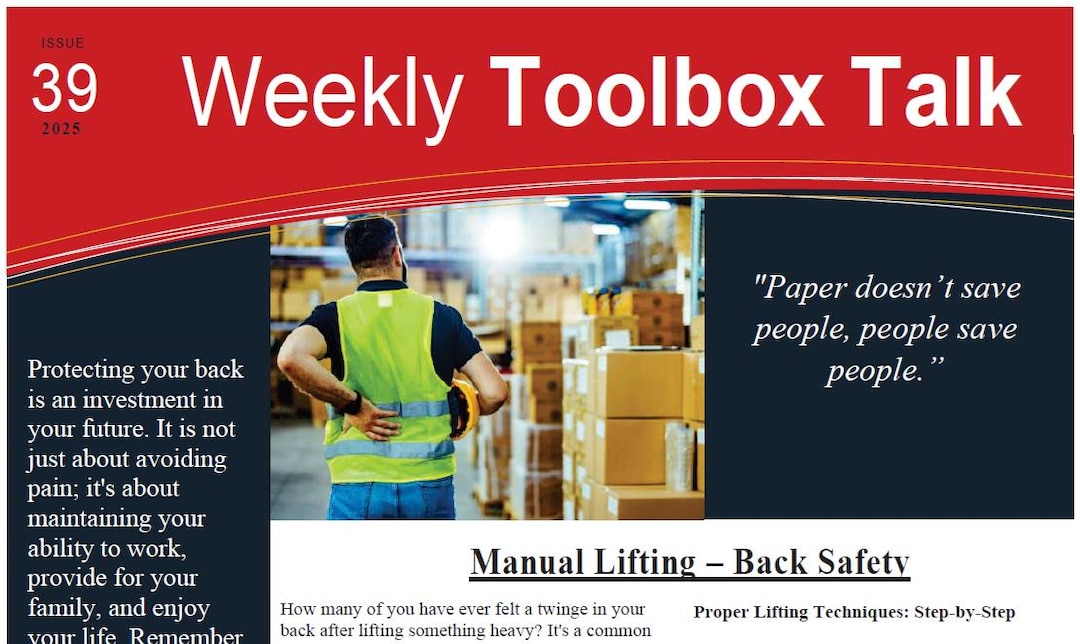
8. Lifting and Material Handling Use case: Frequent back strain reports in warehouse staff.
Demonstrate: - Proper lifting technique (squat, not bend) - Use of mechanical aids (dollies, hoists) - Team lifting coordination
Engagement: Have workers demonstrate correct form in pairs.
9. Emergency Response Readiness Use case: New crew members who don’t know site evacuation routes.
Confirm: - Location of fire extinguishers, first aid kits, AEDs - Emergency contacts and alert systems - Meeting points and headcount procedures
Drill idea: Conduct a surprise 2-minute evacuation check.
10. Mental Health and Focus on the Job Use case: A distracted worker almost backed into a colleague.
Address: - Fatigue, stress, and substance use - Recognizing impaired coworkers - Open-door policy for mental health concerns
Note: This topic requires trust. Leaders must model vulnerability.
How to Structure a High-Impact Toolbox Talk
A strong format keeps discussions focused and participatory. Follow this 5-step workflow:
1. Identify the Hazard (1–2 min) State the issue clearly: “This week, we’ve seen three near-misses with unmarked trip hazards.”
2. Explain the Risk (2–3 min) Connect it to consequences: “A twisted ankle can mean weeks off work—and higher risk of falls from elevation later.”
3. Demonstrate the Solution (3–5 min) Show, don’t just tell. Use real tools, PPE, or site examples.
4. Invite Crew Input (3 min) Ask: “What’s one thing on site right now that could trip someone?” Listen more than you talk.
5. Confirm Understanding (1–2 min) Have each person say one action they’ll take. “I’ll clean my work area before lunch.”
End with signatures or digital log entries—but only after engagement.
Common Mistakes to Avoid
Even with good topics, poor delivery undermines impact. Watch for these traps:
- Repeating the same topics monthly – Workers tune out. Rotate and adapt.
- One-way lectures – No questions, no discussion. This isn’t a monologue.
- Ignoring crew feedback – If workers raise concerns, act on them—or lose credibility.
- Poor timing – Don’t hold talks when crews are rushing to start work or exhausted at shift end.
- Skipping documentation – If it wasn’t recorded, it didn’t happen (from a compliance standpoint).
One superintendent reported a 40% drop in incidents after switching from “top-down” talks to crew-led discussions. The content was similar—but the ownership changed.
Integrating Toolbox Talks Into Your Safety Program
These talks shouldn’t exist in isolation. Link them to:
- Near-miss reporting: Use real incidents as talk starters.
- Pre-job planning: Align topics with upcoming high-risk tasks.
- Safety audits: Verify that talk recommendations are being followed.
- New hire orientation: Include participation from day one.
Example: After a discussion on ladder safety, supervisors conduct spot checks for proper setup. Positive reinforcement increases compliance.
Digital tools help: - Mobile apps that log talks with photos and signatures - Cloud storage for records during OSHA inspections - Automated reminders to prevent missed sessions
But tech doesn’t replace leadership. The foreman or supervisor must lead with consistency and care.
Making Talks Engaging (Without Gimmicks)
You don’t need games or prizes. Real engagement comes from relevance and respect.
Try these: - “Show the Damage” – Display worn PPE or damaged equipment. Ask the crew what went wrong. - “What Would You Do?” – Present a scenario: “You see a coworker bypassing a machine guard. What’s your move?” - “Safety Champion” – Rotate who leads the talk. Empowers quieter team members. - “1-Minute Recap” – At the end of the week, ask one person to summarize the key takeaway.
The goal isn’t entertainment. It’s retention.
Final Thoughts: Quality Over Compliance
Weekly toolbox talks work when they’re human, timely, and action-oriented. A 12-minute conversation can prevent a lifetime of injury—if it’s grounded in real work and real risks.
Stop recycling the same five topics. Start listening to your crew. Use incident data, weather, and project phase to guide your agenda.
Make safety personal.
And next time you gather your team, don’t just talk at them. Talk with them.
Frequently Asked Questions
What should be included in a weekly toolbox talk? A clear topic, hazard explanation, safe practices, crew discussion, and documented attendance. Keep it under 15 minutes and job-specific.
How often should toolbox talks be held? Weekly is standard, but high-risk tasks may require daily talks. Consistency matters more than frequency.
Who should lead a toolbox talk? Supervisors or foremen typically lead, but rotating crew members fosters ownership and engagement.
Are toolbox talks required by OSHA? OSHA doesn’t mandate “toolbox talks” by name, but requires regular safety training and communication—these talks fulfill that need.
Can toolbox talks reduce workplace incidents? Yes—when done correctly. Studies show consistent, interactive safety meetings reduce incidents by 20–50%.
Should toolbox talks be documented? Absolutely. Keep records of date, topic, attendees, and discussion points for compliance and trend analysis.
Can toolbox talks be done digitally? Yes. Many teams use apps to deliver, sign, and store talks—especially useful for remote or multi-site operations.
FAQ
What should you look for in Weekly Toolbox Talk Topics That Actually Improve Safety? Focus on relevance, practical value, and how well the solution matches real user intent.
Is Weekly Toolbox Talk Topics That Actually Improve Safety suitable for beginners? That depends on the workflow, but a clear step-by-step approach usually makes it easier to start.
How do you compare options around Weekly Toolbox Talk Topics That Actually Improve Safety? Compare features, trust signals, limitations, pricing, and ease of implementation.
What mistakes should you avoid? Avoid generic choices, weak validation, and decisions based only on marketing claims.
What is the next best step? Shortlist the most relevant options, validate them quickly, and refine from real-world results.